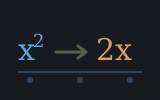
alg is symbolic algebra over AlgEx. Symbolic
algebra works on the formulae themselves, not on the numbers they
produce. The machine holds an expression type, a parser and a printer,
exact rational arithmetic, a canonical-form simplifier, symbolic
differentiation, expansion and factorisation, partial fractions, limits, a
bounded integrator, equation solving, first-order ODEs, and Taylor series.
One more word justifies the machine: AlgToFn turns an
expression into a function value the rest of the tree can call. Every word
is pure (it computes its answer and changes nothing
else) and every word is prefixed Alg.
Read these two before anything else. The machine cannot be used without knowing them. Both are decisions that could not be changed later without rewriting every word: there is no subtraction node and no division node, and numbers are exact rationals.
The expression type has six variants, not eight. a - b is
stored as a sum with a term multiplied by −1. a / b is
stored as a product with a factor raised to −1:
AlgNum(AlgNumer, AlgDenom)     ' exact rational, always normalised
AlgVar(AlgName)
AlgSum(AlgTerms)               ' two or more
AlgProd(AlgFactors)            ' two or more
AlgPow(AlgBase, AlgExpo)
AlgCall(AlgFn, AlgArg)         ' sin, cos, exp, ln, ...
That is extra work at construction, and AlgSubOf and
AlgDivOf hide it. What it buys: every function here has six
cases instead of eight. The real prize is that the simplifier never has to
reason about a - b + b, because there is no subtraction to
reason about. Collecting like terms over a flat n-ary sum (one sum
node holding any number of terms) is one Fold. Over a
binary tree with a subtraction node it is a research project.
AlgShow rebuilds subtraction and division on the way out, so
you never see the representation.
An exact rational is a fraction kept as a whole-number top and bottom,
never rounded. So 1/3 + 1/6 is exactly 1/2, never
0.5. This is what separates a CAS (a computer
algebra system) from a calculator. The moment it is 0.5,
the simplifier cannot tell 1/3 + 1/6 - 1/2 from a small
number, AlgFactor cannot find rational roots, and
AlgPartFrac cannot solve for its coefficients. It is also why
AlgMaclaurin gives you 1/120 and not
0.008333.
A decimal entering the machine is rationalised to the simplest
fraction within a tolerance, by continued fraction, a standard way
of finding the simplest fraction near a value. AlgOf(0.1) is
1/10, not the double’s exact binary value
3602879701896397/36028797018963968. That exact value is
technically faithful but practically useless, and it makes every later gcd
(the greatest common divisor used to reduce fractions)
enormous.
George Peacock (1791–1858) was born at Denton in Wharfedale, in the West Riding of Yorkshire. His Treatise on Algebra of 1830 founded what he called symbolical algebra: the doctrine that algebra is the manipulation of symbols according to stated rules, valid whatever the symbols are taken to mean. Before Peacock, algebra was understood as generalised arithmetic, and an expression had to stand for a quantity. After him, the rules could be studied and applied on their own terms.
That doctrine is this machine’s operating premise, exactly and
literally, not a decorative parallel. AlgDiff
differentiates x^3 without knowing or caring what
x is, because the power rule is a rule about symbols. A
computer algebra system is only possible at all because Peacock was right.
And Denton sits in Wharfedale a few miles from Otley, in the same riding as
the mills this language is named for.
Every calculus and solving word in eng takes a
quotation, a function value passed around as data. None of them
could take a formula, because a formula was not a value anywhere
in the tree. AlgToFn closes that:
Include "alg.shoddy"
Include "eng.shoddy"          ' both — neither includes the other

Def Main()
    Let e = AlgParse("x^3 - 2*x - 5")
    Let f = AlgToFn(e, "x")

    Print(EngZeroOf(f, 2, 3))               ' 2.0945514815 — solved numerically
    Print(AlgShow(AlgDiff(e, "x")))         ' 3 * x ^ 2 - 2 — differentiated exactly
A formula read from a config file, a CSV column header or a user prompt
becomes a function value. Every numeric word in eng accepts it
unchanged. Neither machine includes the other: a quotation
is a builtin type, so they compose with no dependency in either direction.
A program that only wants symbolic differentiation does not drag in a unit
table.
Integration, factorisation, limits, solving, parsing and the ODE solver
all return the language's Result. And Err
here usually means "outside the implemented rules", which is an ordinary
answer about the input rather than a fault:
AlgFactor(AlgParse("x^2 + 1"), "x")
    ' Err("IRREDUCIBLE OVER THE RATIONALS", 0)

AlgInteg(AlgParse("exp(x^2)"), "x")
    ' Err("NO RULE FOR EXP OF A NON-LINEAR ARGUMENT", 0)
The first states a true fact about the polynomial. The second is correct
because exp(x²) has no elementary antiderivative
(no ordinary function differentiates back to it), so no amount of
engineering would find one. Neither says "FAILED", because
that would be a different and less useful claim.
At is 0 where there is no position, and the
1-based token offset where there is. That is how one Result
serves both the parser and the rule boundary.
Print(AlgShow(AlgParse("2*x + 3*x")))        ' 5 * x — simplified on the way in
Print(AlgShow(AlgParse("a - (b - c)")))      ' a - (b - c) — minimal brackets
Print(AlgToNumber(AlgParse("2^3^2")))        ' 512 — ^ is right-associative
AlgParse aborts on a bad parse; it is the one for a test or
a literal. AlgRead is total (it always answers rather
than stopping the program) and returns a Result; it is
the one for anything a user typed. Total covers the arithmetic the
parser does on the way, not only the syntax. The builders fold as
they read, so "1/(1-1)" arrives at a zero denominator with no
/0 anywhere in its text, and comes back as an Err
like any other refusal. Precedence is conventional and pinned:
^ is right-associative (it groups from the right)
and tighter than unary minus. So
-x^2 is -(x^2) and 2^3^2 is 512.
Print(AlgShow(AlgDiff(AlgParse("x * sin(x)"), "x")))   ' sin(x) + x * cos(x)
Print(AlgShow(AlgDiff(AlgParse("x^x"), "x")))          ' x ^ x * (1 + ln(x))

Select Case AlgInteg(AlgParse("exp(2*x)"), "x")
    Case Ok(i)
        Print(AlgShow(i))                              ' (1 / 2) * exp(2 * x)
    Case Err(why, at)
        Print(why)
Differentiation is total: every representable
expression differentiates, so it returns an AlgEx and not a
Result. That is an asymmetry with integration, and it
is worth knowing. The general power rule is implemented, so
x^x works rather than only constant exponents.
Print(AlgShow(AlgOkOf(AlgMaclaurin(AlgParse("sin(x)"), "x", 5))))
    ' x - (1 / 6) * x ^ 3 + (1 / 120) * x ^ 5

Print(AlgShow(Nth(AlgListOf(AlgSolve(AlgParse("x^2 - 2"), "x")), 1)))
' a symbolic square root of 2, not 1.4142135624For a computer algebra system the boundary is as much of the documentation as the capability. A user who discovers the boundary by experiment will not trust the parts that work.
x^n
including n = -1, sin/cos/exp, sums, constant multiples, and
f(ax + b) by linear substitution. Query the table at runtime
with AlgIntegRules(). No Risch algorithm, no
integration by parts, no general substitution.abs(x)/x at 0
returns an Err.Err naming which case it was.y' = g(x) and y' = g(x)·y. Both inherit
every limit of the integrator: an ODE solver on top of a table integrator
is exactly as capable as the table.atan2 and friends are
not in the table, and adding one later means adding a variant rather than
widening this one.AlgRatAdd divides by the gcd of
the denominators before cross-multiplying for exactly this
reason.AlgExpandPow
refuses above its bound rather than attempting it, because the alternative
failure mode is a mill that never returns.AlgToFn walks the tree on every call.
That is fine for a solver making a hundred evaluations, and not fine in a
tight numeric loop. AlgSimplify first; past that, this machine
is for symbolic work and eng is for numeric
work.Never compare two AlgEx with =: structural
equality reports x + y and y + x as different.
AlgEqual simplifies both and compares canonical forms,
the one standard shape the simplifier reduces every expression to. It is
the only equality this machine offers.
But canonical-form equality and mathematical equality are not the same
thing. 1/(x*(x+1)) and 1/(x^2+x) are the same
function and are not AlgEqual. The canonical
form neither factors a denominator nor expands one. It has no basis
on which to choose. Use AlgExpand or AlgTogether
first when the two sides may disagree about that. A False
means "not the same canonical form", which is a weaker claim than "not
equal".
| Word | Description |
|---|---|
| AlgRat(n, d) | The only constructor of a number. Sign on the numerator, denominator positive, gcd divided out. Errors on a zero denominator. An AlgNum built any other way compares unequal to its own normal form and breaks the total order silently. |
| AlgExact(n, d) | The same, for a caller who already has a fraction. |
| AlgOf(x) | A Number to the simplest rational within tolerance, by continued fraction. |
| AlgZero / AlgOne / AlgMinusOne | The three constants worth having by name. |
| AlgPiSym / AlgESym | pi and e as symbols, not values, which is why sin(pi) simplifies to exactly 0. |
| AlgNumOf / AlgDenOf / AlgToNumber | Read a number out. Error unless it is one. |
| AlgIsNum / AlgIsZero / AlgIsOne / AlgIsInt | Ask what it is. |
| AlgRatAdd / AlgRatMul / AlgRatDiv / AlgRatNeg / AlgRatCmp | Exact arithmetic on two numbers. |
| Word | Description |
|---|---|
| AlgVarOf(name) | A symbol. |
| AlgAddOf / AlgSubOf / AlgMulOf / AlgDivOf / AlgNegOf | The four operations and negation. AlgSubOf and AlgDivOf build the sugar the type does not have; AlgDivOf errors on a zero divisor. |
| TryAlgDivOf(a, b) | → Result. AlgDivOf's guarded twin: Err("DIVISION BY ZERO", 0) instead of the abort. AlgDivOf is defined over it, so there is one rule and not two. This is the form the parser calls, and the form to call on a divisor a stranger chose. |
| AlgSumOfList / AlgProdOfList | The n-ary forms. |
| AlgPowOf(b, e) / AlgSqrtOf(a) | Powers. The identities apply here, so x^0 is 1 and x^1 is x before anything downstream sees them. 0^e is 0 for a positive e and errors for a negative one: that is a division by zero spelt differently. A symbolic e of unknown sign is left unevaluated rather than guessed at. |
| TryAlgPowOf(b, e) | → Result. AlgPowOf's guarded twin, refusing 0^-1 in the same words TryAlgDivOf refuses 1/0. They are one question and get one answer. The parser's ^ branch calls this. |
| AlgCallOf(fn, arg) | A function call. Errors on a name not in the table rather than building something nothing downstream can differentiate or evaluate. |
Every builder simplifies as it goes.
AlgAddOf(x, AlgZero()) returns x, not a
two-element sum. That is not an optimisation. It is what keeps the
two-or-more invariant true, and it means most expressions reach
AlgSimplify already close to canonical.
| Word | Description |
|---|---|
| AlgParse(s) | → AlgEx. Aborts on a bad parse. For tests and literals. |
| AlgRead(s) | → Result. Total; Err carries the 1-based token offset in At. For anything a user typed. |
| AlgShow(e) | Minimally parenthesised infix, reconstructing subtraction and division. |
| AlgShowFull(e) / AlgTree(e) | Fully bracketed, and the indented tree. Both for debugging. |
| Word | Description |
|---|---|
| AlgSimplify(e) | Repeats rewriting passes until nothing changes: a capped fixpoint. One pass is not enough: collecting terms creates constants to fold, and folding creates identities to drop. So it repeats, and errors on overrun rather than hanging. |
| AlgPass(e) | One rewriting pass, exposed for testing. |
| AlgCompare(a, b) | The total order: −1, 0 or 1. Numbers, then variables, then powers, products, sums, calls. |
| AlgEqual(a, b) | The only equality. See the caveat above. |
| AlgSort(xs) / AlgTogether(e) | Canonical ordering of a term list; and a sum of fractions put over one denominator, the inverse of AlgPartFrac. |
| AlgDepth / AlgSize / AlgVarsOf / AlgHasVar / AlgIsConst | Inspection. |
| AlgTwoOrMore(e) | The invariant, exposed so a test can assert it: no sum or product ever holds fewer than two elements. |
| Word | Description |
|---|---|
| AlgDiff(e, var) | First derivative. Total, and simplified before returning: the second derivative of x^3 is unreadable unsimplified and the third unprintable. |
| AlgDiffN(e, var, n) | The nth. |
| AlgGrad(e, vars) | One partial per variable. |
| AlgFns() / AlgKnowsFn(name) | The function table, and whether a name is in it. |
| AlgDiffFn(name, u) / AlgEvalFn(name, x) | The derivative and the numeric value of each. Both must exist for every name in AlgFns(). One without the other breaks AlgToFn or AlgDiff, and the test suite asserts they are in step by iterating the table. |
| Word | Description |
|---|---|
| AlgExpand(e) / AlgExpandPow(e) | Distribute. Total: every product of sums can be expanded, which is the asymmetry with factorisation. |
| AlgFactor(e, var) | → Result. Univariate, over the rationals. |
| AlgCommonFactor(e) | Pull out the integer common factor of a sum. Total. |
| AlgPolyDegree / AlgIsPoly | Degree in one variable, -1 when it is not a polynomial in it. |
| AlgPolyCoeffs(e, var) | → Result. Lowest power first, so index k is the coefficient of var^k. Unpack with AlgCoeffList. |
| AlgCoeffAt(e, var, k) / AlgFromCoeffs(cs, var) | One coefficient; and the polynomial back from a list. |
| AlgPolyDivide / AlgPolyRem | → Result. Quotient and remainder from one walk. |
| AlgPartFrac(e, var) | → Result. Distinct linear factors, by the cover-up rule. |
| Word | Description |
|---|---|
| AlgLimit(e, var, at) | → Result. Substitution, then bounded L'Hôpital on a quotient. |
| AlgLimitInf(e, var) | → Result. Degree comparison, rational functions only. |
| AlgInteg(e, var) / AlgIntegDef(e, var, a, b) | → Result. Indefinite (no constant) and definite. |
| AlgIntegRules() | What the table covers, as text, so a caller can find out what will work without reading the source, and so this page can be checked against it. |
| AlgSolve(e, var) | → Result holding a list. Ok({ }) means no solutions; Err means no method. Those are different facts and a caller can act differently on them. |
| AlgSolveFor(lhs, rhs, var) | The same, with the right-hand side moved across. |
| AlgSolveLinear / AlgSolveQuad | The two closed forms. The quadratic keeps an exact discriminant, so a surd stays symbolic. |
| AlgDeSolve(rhs, y, x) | → Result. First-order only; the arbitrary constant appears as C. |
| AlgTaylor / AlgMaclaurin | → Result. Exact rational coefficients. |
| Word | Description |
|---|---|
| AlgSubst(e, var, r) | Replace a variable with an expression. |
| AlgSubstFn(e, name, param, body) | Replace calls to a function with a body written in param. The name must be one the table knows. |
| AlgEvalAt(e, var, x) | → Number. The boundary where pi and e become values. An unbound variable is an error naming it, never a silent zero. |
| AlgEvalWith(e, names, values) | The same with several variables, as two parallel lists. |
| AlgToFn(e, var) | The bridge. → [ Number -- Number ], which every numeric word in eng accepts. |
| AlgToFn2(e, v1, v2) | The two-variable form. |
| AlgOkOf(r) / AlgWhyOf(r) / AlgIsErr(r) / AlgAtOf(r) / AlgListOf(r) | Reading a Result without a Select Case, for a caller who has already checked or a test that knows the answer. AlgOkOf errors on an Err. |
No machine and no mill includes it yet. Its words are already at the reckoner's prompt through its seed, and a mill that puts them to work will appear here.
| Machine | Why | |
|---|---|---|
 | seq | Flatten is the whole of expansion and variable collection, All and Any carry the invariants, Append and Taken build the coefficient lists, and IndexOf looks up a binding. |
 | sinq | OrderWith is the canonical ordering of terms and factors: AlgCompare is already a comparer, so the insertion sort this machine used to carry is gone. Distinct collects the variable names. |
 | str | Join assembles the printer's output and StrRep indents AlgTree. |
Not eng, and not bool. The three do not overlap and none
includes another. eng is continuous mathematics over Number, bool is discrete logic over bit patterns and Boolean, and this is algebra over AlgEx.
AlgToFn is the bridge, and a quotation is a builtin type, so
it costs neither machine a dependency.
 Shoddy · The Machines