Shoddy Documentation
The rag trade of the West Riding, and why this language is built the same way
In 1813, in Batley, a clothier (a maker of cloth) named Benjamin Law worked out how to do something the wool trade had thought impossible: make new cloth from old. The towns around him built an entire industry on the idea. They were Ossett, Morley, Dewsbury and Wakefield, the “Heavy Woollen District” of the West Riding of Yorkshire. Rags flowed in from everywhere: from rag-and-bone men working British streets, and by the ton from Europe and beyond.
Women did most of the sorting, by hand, by color and grade. That was a skill in itself. Then the rags went into a spiked grinding machine the trade called the devil, which tore the old cloth back into loose fiber.
Soft rags (old knitwear, stockings) yielded shoddy. Hard, felted tailor's cloth needed a fiercer process, worked out a couple of decades later, and yielded the finer mungo, a Batley coinage. The reclaimed fiber was blended with a proportion of new wool. It was then carded (combed straight), spun on mules (the great spinning machines of the day), and woven into cloth again.
One of those towns, Ossett, put the whole idea on its coat of arms: Inutile Utile Ex Arte, “the useless made useful by skill.” That motto, in English, is this project's tagline.
Shoddy cloth dressed the people that virgin wool (new, never-used wool) priced out. It became cheap suits, overcoats and blankets for the working class, at home and for export. It became pilot cloth, a heavy blue wool for sailors' coats, and druggets, a coarse, hard-wearing cloth. Above all, it became uniforms.
The Crimean War, the Franco-Prussian War and both World Wars were fought largely in reclaimed Yorkshire wool. The mills' order books rose and fell with the world's armies. The American Civil War ruined the word. Union contractors supplied uniforms of such poor recycled cloth that they reportedly dissolved in the rain, and “shoddy” crossed the Atlantic as a slur.
That was a little unjust to Ossett, Morley and Wakefield, where the good mills made honest cloth and their owners' fortunes built town halls and chapels. Even the waste had a use: unspinnable dust was sold as fertilizer for the hop gardens of Kent. Nothing left the mill useless.
After the Second World War the trade failed from two directions at once. Nylon, polyester and acrylic made new fiber cheaper than reclaimed wool, which removed shoddy's whole reason to exist. Worse, the synthetics spoiled the supply of rags itself. The rag stream filled with blended fabrics that could not be sorted into pure wool or torn back into spinnable fiber, so the devil had nothing left it could process.
Tastes moved to lighter cloth in centrally heated homes. Armies went synthetic. The mills thinned through the 1950s and 60s. By the 1980s an industry that had run for a century and a half was effectively gone. At the same time the wider world began rediscovering, under the name “textile recycling,” the thing the West Riding had industrialized in 1813.
The analogy runs deeper than the name. Shoddy-the-language was made the
way shoddy-the-cloth was: nothing in it is new fiber. Its parts came from
older languages and older systems: BASIC's keywords, Forth's stack, Joy's
quotations, QuickBASIC's Type, VB's IsEmpty, and
ISAM from the mainframe age. Old cloth, gathered and sorted.
The lexer, the
part of the toolchain that splits source text into its smallest pieces, is
the devil: it tears source into fibers. Desugaring is the carding and
re-spinning: it turns convenient surface syntax into core thread. A
proportion of new wool is blended in, because pure reclamation was never
the whole recipe: closures (functions that remember the variables around
them), pattern matching, and root Let. The
mill weaves it, the machines are its
equipment, and programs are the cloth.
The golden files (saved correct outputs that every test run must match) are the cloth-hall inspection that decides whether a piece is true. Even the slur is part of the inheritance. The name invites the world to expect rubbish, and the product's job is to be better than its reputation, the oldest trick in Batley. The industry's ending is the analogy's warning, and it has been heeded. When the old material could no longer sustain the process, the answer was not to stop reclaiming but to move to new fiber. That is what the .NET mill is.
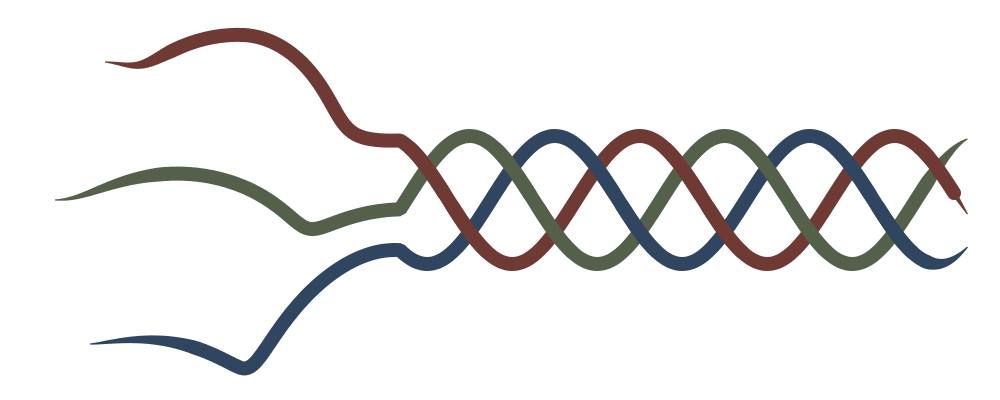
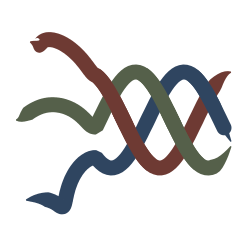
The project's mark tells the same story in a single line. Three threads enter loose from three directions, like rag stock, tangled and unsorted. From about the two-fifths mark they run woven, over and under, into one continuous plait. The icon is the same gesture compressed to a square.
The colors are the trade's own. Reclaimed fiber could never be bleached, only dyed darker, so the Heavy Woollen District worked at the dark end of the dye book. Each thread wears one of its staple shades:
#6E3A33): the red of army cloth and
overcoatings;#55604A): the workaday shade of mixed,
color-sorted rag stock;#2F4560): the blue of pilot cloth, the
district's heavy staple.They are also, deliberately, a shade of R, a shade of G and a shade of B: red, green and blue, the primaries of the new loom, dyed in the old lots.
 Shoddy · Documentation