isam lets a Shoddy program save records to a file and find
any one of them again later by a key: a name, an ID number, whatever
makes that record unique. Think of it like a box of index cards kept in
alphabetical order. On top sits a little tabbed guide that tells you exactly
which card to pull, instead of flipping through the whole box. You open the
file and get back a handle, which is your working connection to that box of
cards.
The tabbed guide itself is saved on disk too, in a small companion file
next to your data. So opening the box again later is instant, with no
re-sorting, no matter how many cards are in it. Every change you make is
written straight to disk the moment you make it. So one handle is all you
ever need: open the file, use db everywhere, close it when
you're done.
ISAM stands for Indexed Sequential Access Method. It is an idea from the 1960s, when IBM built it for the big business computers of the day. Companies back then had the same problem you would have with a giant box of unsorted index cards. You could read through every card in order, which was fine for printing a whole report, but slow if you only wanted to find "the one card for employee #4471." Or you could jump straight to one card, but then it was hard to read them all back out in a sensible order.
ISAM's big idea was to get both at once. Records were kept in order by their key. A separate index (like the tabs on a filing cabinet) let the computer jump straight to the record it wanted, without reading every card in front of it. This became one of the standard ways that banks, payroll systems, and other business software stored data for the next twenty-plus years. It was gradually replaced by more advanced systems: VSAM, and eventually the databases we use today.
But the core idea never went away: keep things in order, and keep a separate index that points to where each thing lives. It is still how things work today, nearly everywhere you look. Every SQL database (MySQL, PostgreSQL, SQL Server, the database behind almost any app or website you have used) finds a row by key the same way. It does not scan the whole table. It walks an index (usually a tree-shaped one, a descendant of the same idea) straight to the answer. That is the difference between a search that takes a fraction of a second and one that takes minutes on a big enough table.
Search engines lean on the same trick at a much bigger scale. Instead of indexing rows by an ID, they index words by which pages contain them. So looking up "which pages mention this word" is also a fast index lookup instead of a read-everything scan. Different data, same core move: sort it, index it, and you can jump straight to the answer instead of hunting for it.
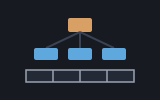
This machine borrows that same idea, without needing a 1960s mainframe. Like its ancestors, and like the databases that followed them, it keeps the index on disk as a tree, in a small companion file beside your data. The tree is a B+tree, the same shape SQL databases still use: a wide, shallow tree of pages that keeps keys sorted and quick to reach. Opening the file, looking something up, and saving it is all done with ordinary Shoddy values and functions: no special hardware, no punch cards required.
A lot of programs need to keep track of things that change all the time:
prices go up, inventory gets sold, students get new grades. And they must
remember those changes even after the program stops running. That means
saving data to a file, and being able to find one record quickly: find
student #4471, not "read every student until you happen to hit #4471."
That is exactly what isam does. It saves records to a file
and keeps a fast index, so you can look any one of them up by key right away,
instead of scanning the whole file. Reach for it whenever a program needs to
store a set of records between runs (inventory, accounts, a class
roster) and needs to find, add, change, or remove one of them by key
without re-reading everything else.
To use isam, you tell it three things about the kind of
record you want to store: how to read one record from the
file, how to write one, and how to get the key
back out of a record once you have it (its name, its ID, whatever
you will look it up by). A key has to be a Number or a
String, since those are the kinds of value Shoddy knows how to
put in order.
Include "isam.shoddy"

Type Staff
    Name  As String
    Score As Number

Def RdStaff(f As Number) As Staff
    Staff(GetStr(f, 12), GetNum(f))

Def WrStaff(f As Number, s As Staff)
    PutStr(f, Name(s), 12)
    PutNum(f, Score(s))

Def StaffKey(s As Staff) As String
    Name(s)

Def Main()
    Let db = IsamOpen("staff.dat", 20, RdStaff, WrStaff, StaffKey)
    IsamInsert(db, Staff("ADA", 96))
    IsamInsert(db, Staff("LIN", 78))

    Print(Score(IsamGet(db, "ADA")))               ' 96
    Print(IsamCount(db))                            ' 2
    Each(IsamAll(db), Fn(s) => Print(Name(s) & ": " & Str(Score(s))))
                                                     ' ADA then LIN, key order

    IsamClose(db)
The 20 in IsamOpen is the number of bytes
one record takes up on disk: 12 for the name, 8 for the score, in this
example. Your reader and writer need to agree on that number, or the file
will be read back scrambled. A few things worth remembering:
db for everything until you
close it, the way the example does. (IsamInsert,
IsamUpdate, and IsamDelete do hand the handle back.
An earlier version of this machine kept the index inside the handle, and code
written for it threaded each returned handle into the next call. That still
works, but there is no longer any reason to: the returned handle is the
one you passed in, unchanged.)staff.dat also creates staff.dat.idx next to it.
That is the index, saved on disk so reopening is instant. If you
copy or move the data file, bring the .idx along. If it ever
goes missing, the next open quietly rebuilds it by reading the whole file
once.IsamAll hands you every record, already sorted by key, as an
ordinary list. IsamFirst, IsamNext,
IsamPrev, and IsamLast let you step through one
record at a time if you would rather do that instead.IsamGet,
IsamUpdate, IsamDelete, and a few others)
will raise an error if you ask about a key that does not exist. Check
first with IsamHas, or use IsamGetOr, which gives
you a default answer instead of stopping the program.You do not need any of this section to use the machine. It is here for the curious, and for anyone staring at the files in a hex viewer (a tool that shows a file's raw bytes).
The data file is the box of cards itself: one fixed-size
slot per record, each slot being 1 + size bytes: a
one-byte live flag, then the bytes your writer produced. Deleting a record
flips its flag to dead and threads the slot onto a free list, a chain of
slots waiting to be reused. The first 8 bytes of a dead slot's payload
hold the slot number of the next free slot, so the free list costs no space
of its own. One consequence: records smaller than 8 bytes cannot hold that
pointer, so their freed slots are never reused.
The index file (path & ".idx") is the
tabbed guide. It starts with a 24-byte header: where the root of the tree is,
how many records are live, and where the free list starts. After that come
fixed-size pages holding a B+tree of order 16, sixteen branches to a
page. Leaf pages list records in key order and chain left to right, which is
what makes IsamAll, IsamRange, and
IsamNext walks cheap. Interior pages hold the signposts that
steer a lookup to the right leaf.
Keys are never written into the index. Shoddy cannot
ask a value "are you a Number or a String?" at runtime. So instead of storing
keys in some fixed-width encoded form, every index entry stores a slot
number. The key is re-derived by reading that record and applying your
keyOf, which is why both key types work, with no
maximum key length. The interior signposts must stay stable when slots are
deleted and reused. So each leaf split appends one frozen, dead-flagged copy
of a record (a "separator image") for the signpost to point at. That is
the permanent scaffolding mentioned above: roughly one small slot per
eight inserts. Along with index pages, which are never merged after deletes,
it is the deliberate bit of waste this machine accepts. Shoddy by
name.
What things cost: IsamOpen,
IsamClose, and IsamCount are O(1) (constant
time, however big the file is) because opening reads the header, never
the records. Lookups, inserts, updates, deletes, and IsamNext
descend the tree: a handful of pages, with one record read per key compared
along the way. IsamPrev walks the leaf chain from the left up to
your key, and IsamLast walks the whole chain: the two
slowest of the family. If the .idx is missing beside a data
file that has records, the next open rebuilds it with a one-time full scan. A
stale .idx sitting beside a fresh, empty data file is detected
and discarded. No crash safety, no sharing: one program, one live handle at a
time.
Every word, plus the Isam type
| Word | Description |
|---|---|
| Isam | Your claim ticket for an open file: the two file
connections and your reader, writer, and key functions, bundled into one
value. You will pass this to almost every other word below. It never changes
after IsamOpen; all the state lives on disk. |
| Word | Description |
|---|---|
| IsamOpen(path, size, rd, wr, keyOf) | Opens (or creates) the
file at path (plus its index at path & ".idx")
and hands you back your ticket (Isam). Fast no matter how
big the file is: it reads a small header, not every record. size
is how many bytes one record takes up; rd and wr
are your read/write functions; keyOf tells it how to find a
record's key. |
| IsamClose(db) | Closes the file when you are done with it. |
| Word | Description |
|---|---|
| IsamHas(db, k) | True or False: is there a record saved under
key k? Good to check before looking something up that might not
be there. |
| IsamCount(db) | How many records are currently saved. |
| IsamGet(db, k) | Gives you the record saved under key
k. Stops the program with an error if that key does not
exist. |
| IsamGetOr(db, k, dflt) | Same as IsamGet, but
gives you dflt instead of an error when the key is
missing. |
| Word | Description |
|---|---|
| IsamInsert(db, rec) | Saves a brand-new record. Stops the
program with an error if a record with that key is already saved. Use
IsamUpdate instead if you mean to replace one. |
| IsamUpdate(db, rec) | Replaces the record that has the same
key as rec. Stops the program with an error if there is no
existing record with that key to replace. |
| IsamDelete(db, k) | Removes the record saved under key
k. Stops the program with an error if that key does not
exist. |
| Word | Description |
|---|---|
| IsamAll(db) | Every saved record, as a list, sorted by key. |
| IsamRange(db, lo, hi) | Every saved record whose key is
between lo and hi (both included), sorted by
key. |
| IsamFirst(db) | The record with the smallest key. Stops the program with an error if nothing is saved yet. |
| IsamLast(db) | The record with the largest key. Stops the program with an error if nothing is saved yet. |
| IsamNext(db, k) | The record whose key comes right after
k. k itself does not have to be saved:
this finds the first record whose key is bigger than k, whether
or not k is in the file. Stops the program with an error if
there is nothing after k. |
| IsamPrev(db, k) | The record whose key comes right before
k. Like IsamNext, works whether or not
k itself is saved. Stops the program with an error if there is
nothing before k. |
No machine and no mill includes it yet. Its words are already at
the reckoner's prompt through its seed. Its
exercise otherwise lives in tst/:
isamtest.shoddy, isamdump.shoddy and
isamfixture.shoddy.
None. isam stands on the file and record builtins alone. It used to include seq without naming a word from it.
Not recio, despite appearances: isam speaks to
the binary builtins (Seek, PutNum,
GetStr and kin) directly. The two are siblings on the
same foundation, not layers of one another.
 Shoddy · The Machines