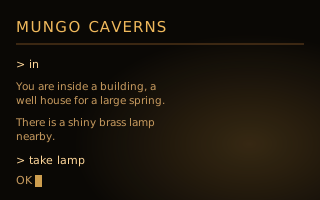
mungo-caverns is the text adventure every other text adventure
came from, rebuilt in a language with no assignment: a value, once made, is
never changed. You stand at the end of a road before a small brick building.
Below it is a cave of 185 rooms holding twenty treasures, a lamp with 330
turns of battery in it, a pirate who steals what you are carrying, and five
curmudgeons who throw axes at you. Commands are one or two words, significant
to their first five letters (which is why the game asks for ne
rather than northeast), and the magic words still work. Four
hundred and thirty points are on offer. The game will tell you what rank you
earned and how far short of the next one you fell.
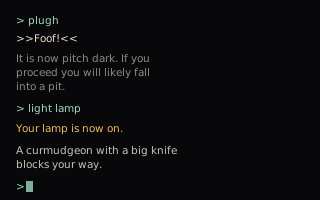 A turn in the darkthe lamp, the pit warning, and one of the five curmudgeons
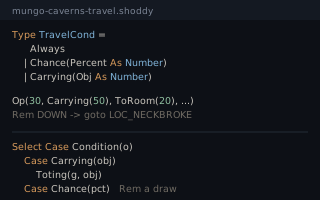 The travel tablea cave database the compiler checks
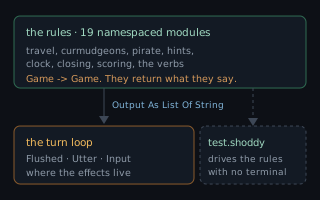 What the rules returnoutput is a value until the turn loop utters it
This mill is a Shoddy forward-port of Eric S. Raymond's
Open Adventure, itself a forward-port of Crowther and Woods'
Adventure 2.5 (1995). Because it derives from that work it carries the
BSD 2-Clause License rather than the repository's MIT; see
mills/mungo-caverns/LICENSE and
THIRD-PARTY-NOTICES.md.
Will Crowther wrote the first version in the mid-1970s. He was a caver and a Fortran programmer, mapping Mammoth Cave for his daughters. Don Woods added most of what makes it a game in 1977. Everything the genre has done since is downstream of it: the two-word parser, the room description that shortens once you have read it, the light source that runs down, the maze of twisty little passages. It reached this port through Open Adventure, which is maintained as C and, crucially, ships about 107 recorded transcripts of real games, the commands typed and everything the game printed back. This port was developed against those transcripts and reached byte-for-byte agreement on all 107, which is why the mill is as faithful as it is. They are Open Adventure's and are not redistributed here; what ships and what runs are the five suites below.
Two things were renamed on the way in. The game is Mungo Caverns, after the mungo of the Yorkshire shoddy mills (the heritage of the name). The knife-throwing folk who prowl the deep passages are curmudgeons. Both renames are total and mechanical. That is what let the grading harness map a recorded 1977 game onto this one and still demand byte-for-byte agreement.
bin/mill run mills/mungo-caverns/mungo-caverns.shoddyor, from mills/mungo-caverns/, use the wrapper,
./build.sh, or ./build.ps1 on Windows, with the
same subcommands:
./build.sh          # play (also: ./build.sh run)
./build.sh test     # every headless suite                (~20 seconds)
It is a plain console program (prompts in, text out, no window), so it runs anywhere the mill does. Three switches travel with it:
-o plays the 4.30-style interface. There the one-letter
abbreviations added after 1977 (l, x,
g, z, i) are not words, and every token
is upper-cased and cut to ten characters, exactly as packing five sixbit
characters into a 32-bit word once did.-r FILE resumes a saved game at startup.-cheat writes save files with a field forced to an impossible
value. That is how the test suite checks what resume does with a file no
real game could have produced.A fourth, -d, dumps every draw from the random number
generator along with the curmudgeons' decisions. It is the only practical way
to see what the stream did when two runs diverge.
It also ships on the Shoddy
Reckoner's games shelf, running the -o interface. There
SAVE and LOAD land in the app's own storage;
it is the same woven program, unmodified.
Twenty-seven source files, about 11,000 lines, 544 Defs and 234
top-level Lets, the cave's tables and constants, built once at
load rather than rebuilt on every read. Rather more than half of that is the
cave itself rather than code: 185 rooms, 70 objects, 878 travel rows, 213
messages, 134 vocabulary entries with their synonyms, ten hints, eleven rank
classes and three obituaries. All of it is Shoddy source, hand-edited.
That last point is the mill's first design decision, and the one everything else follows from. The port started the way the C original works: a YAML database (YAML is a plain-text format for structured data) and a generator that emits code from it. That arrangement was retired. The generated Shoddy is the source now, and both the YAML and the generator are gone. What was bought with that is a database the compiler checks. A room with a missing field, or a travel row naming a condition that does not exist, is a compile error in the same pass that compiles the rules, rather than something a code generator either notices or does not.
The rules divide into nineteen namespaced modules (each included under its own name) covering travel, curmudgeons, the pirate, the clock, the closing sequence, hints, scoring, fighting, liquids, the verbs, save and resume, and the turn itself. They sit over a core holding the generator, the tokenizer (which cuts a typed line into words) and the word classifier. One file, one idea; the file names say which.
A cave crawl has always been two programs. There is a database (what rooms exist, what is in them, which words go where) and an interpreter that walks it. The genre survived its own decade because the second one is small. The interesting question for a language is what the first one is written in; that is what a DSL is, a domain-specific language, a small language built for one job. In the C it is YAML compiled to arrays of small integers whose meanings live in comments. Here it is Shoddy, and a handful of ordinary features of the language do all the work.
Record literals make the tables values. A record is a
bundle of named fields. A room is a record; the cave is a
List Of Room; the whole database is a handful of
Defs returning literals. Nothing parses at startup.
Room("LOC_START",
        "You are standing at the end of a road before a small brick\n"
      & "building.  Around you is a forest.",
    "You're in front of building.",
    { "FLUID", "ABOVE", "LIT" },
    172, False, { }),
Note the condition flags: a list of names, not a packed bitmask, the bits
of one number used as on/off switches. The C packs them because a 1977 machine
had reasons to. There is no reason to here, and the rules read better for it:
Contains(Conds(RoomAt(g)), "LIT") says what it means.
Discriminated unions replace the magic integers. A
discriminated union is a type whose value must be exactly one of a few named
shapes. The rule the port works to is: if a comment has to explain what
the number means, the comment should have been a type. A travel row's
condition was a code plus two arguments. Here it is a TravelCond,
and where it leads is a TravelDest.
Type TravelCond = Always | Chance(Percent As Number)
                | Carrying(Obj As Number)
                | CarriedOrHere(Obj As Number)
                | NotInState(Obj As Number, State As Number)

Type TravelDest = ToRoom(Room As Number)
                | ToMessage(Msg As Number)
                | ToSpecial(Which As Number)
And Select Case destructures them, so the interpreter
is a page long and cannot forget a case. This is the entire
condition evaluator:
Def CondHolds(g As Game, o As Op) As Boolean
    Select Case Condition(o)
        Case Always
            True
        Case Chance(pct)
            RollOf(g, 100) < pct
        Case Carrying(obj)
            Toting(g, obj)
        Case CarriedOrHere(obj)
            Toting(g, obj) Or Contains(HereList(g), obj)
        Case NotInState(obj, st)
            Nth(Props(g), obj + 1) <> st
The type shows its value immediately next door. Some conditions cost a draw
from the random number generator (the source of the game's dice rolls) and
some do not. Getting that wrong is the one way this port can break silently: a
rule that draws one extra number diverges every seeded game from that moment
on. (A seeded game starts its random numbers from a known value, so the whole
run can be replayed.) With the union in hand that hazard collapses into one
small function, CondSpends, saying plainly that
Chance rolls and nothing else does. A
"no‑curmudgeons" rule is encoded upstream as Chance(100).
It always passes and still spends a number. Naming it apart from
Always is what keeps it from looking like a redundant test
somebody could tidy away.
Sum types are used for the small vocabularies too, not
only the big table; a sum type is another name for a discriminated union. A
parsed word is a Kind (motion, object, action, the magic word, a
number, or unknown); what a verb wants done with the rest of the command is a
Phase; how the game ended is a Fate; whether a line
was typed or input ran out is a Line. Each replaces a convention
that was previously a comment next to an integer.
Select Case True is the guard chain the
rules reach for constantly, a list of cases where the first match wins. It
reads like the prose in the original source:
Select Case True
    Case IsHidden(g, rod2) Or Not Closed(g)
        Done(VoicedId(g, msgRequiresDynamite), GoClearObj())
    Case Here(g, rod2)
        Done(With(VoicedId(g, msgSplatterMessage), Bonus = 1, Outcome = Won()), GoClearObj())
    Case Location(g) = LocNamed("LOC_NE")
        Done(With(VoicedId(g, msgDefeatMessage), Bonus = 2, Outcome = Won()), GoClearObj())
    Case Else
        Done(With(VoicedId(g, msgVictoryMessage), Bonus = 3, Outcome = Won()), GoClearObj())
Named-field construction and With carry the state.
The game is one record of forty-five fields threaded through every rule. It is
built by name rather than by position, and not as a matter of taste. Given
positionally, inserting a field in the middle silently shifts every argument
after it into the wrong field, and nothing fails to compile. Updates are the
same shape. With(g, Turns = Turns(g) + 1) returns a new game
rather than altering one, and the old one is still in hand. That is how the
turn loop tells that the cave slammed shut on this turn rather than
an earlier one: it asks whether the game before the clock ticked was still
open.
Namespaces are put on the code and deliberately kept off the
data. A namespace is a named compartment, so the same word can mean
different things in different modules. Each rule module is included under a
name (Include "mungo-caverns-verb.shoddy" As Verb) so a bare
word resolves locally first, then in its own module. A real clash across
two modules is a compile error that tells you to write
Name In Verb. The six data tables share one flat namespace on
purpose. Tag is declared by Room, Obj,
Vocab and Hint alike, and one word serving all four
is the point. Namespace them and Tag becomes four different words
with In at every call site.
Two more small things are worth stealing. Pipelines let a scoring rule read like its own specification:
Def MaxTreasure() As Number
    Range(1, Length(objects) - 1)
        Filter(ScoresAsTreasure)
        Map(TreasureValue)
        Fold(0, +)
And a Let at the left margin runs once at load, which is
where the name-to-index lookups live. The tables are addressed by small
integer, as they have been since 1977. But the rules say
ObjNamed("BOTTLE"), and the lamp, the grate and the keys are
resolved to constants at startup, because the darkness check consults the lamp
on every single turn.
The mill's largest structural decision is that the rules do not
print. A rule that speaks returns a game that has more to say:
output accumulates as a List Of String on the Game
record, and the turn loop drains it.
Def Voiced(g As Game, msg As String) As Game
    With(g, Output = Both(Output(g), Voice(msg)))

Def Flushed(g As Game) As Game
    Utter(Output(g))
    With(g, Output = Silent())
It sounds like bookkeeping, and it changes what can be tested. A rule that
emits its own text can only be checked by capturing a console. A rule that
returns it is a function, and test.shoddy can reach in and grade
one rule at a time: that the bear announces himself before the room does,
that an empty message produces no output at all rather than a stray blank
line, that a fresh game has said nothing yet.
The purity has stated exceptions. Ten sites ask a question mid-turn: offering a hint, confirming a quit, offering a resurrection. Each is a read between two writes, so each flushes what has been said and then reads. Save and resume touch files. Those aside, everything from the parser down runs headless, and the turn loop that remains is thin enough that there is nowhere in it for a bug to hide.
The purity above is a claim, and a claim about testability is only worth what its tests are. There are 1,270 lines of them and 194 assertions against 11,000 lines of game, in five suites that run in twenty seconds.
They exist because a turn is a function. Command, the whole
dispatch (the parser's five rewrites, the verbs, moving, the curmudgeons'
reply, the pit, dying) lives in mungo-caverns-turn.shoddy and
returns a Game. Only the prompt, the flush and the decision to
go round again are left in the shell. So the entire test harness is this:
Def Step(g As Game, line As String) As Game
    Let d = Command(ClockTick(With(g, Turns = Turns(g) + 1)), line)
    Let settled = Settled(After(d))
    If Redescribes(How(d)) Then
        Shown(settled, True)
    Else
        settled
Twelve lines, and the cave can be held still anywhere in it.
tests/test-turn.shoddy stands in the dark with the lamp off,
unlocks the grate with and without the keys, checks that lamp get
and get lamp mean the same thing, and suspends a game and reads
it back. The check that matters most is the one no amount of playing could
perform reliably: whether a rule touched the random number
generator, which is the single way this port can break silently:
Rem The pit roll is guarded by three tests. In the light the roll must
Rem not happen at all -- drawing anyway would cost one number a turn and
Rem put every seeded game out of step within a few moves.
Assert(LcgState(PitCheck(litRoom)) = LcgState(litRoom),
       "THE PIT DOES NOT ROLL IN A ROOM YOU CAN SEE")
Assert(LcgState(PitCheck(inDark)) = LcgNext(LcgState(inDark)),
       "AND ROLLS EXACTLY ONCE IN THE DARK")
Scoring gets the same treatment. A played session can only ever show you the total. Held still, each of the seven terms can be isolated by setting one field and asking what changed: thirty for the lives you have not spent, twenty-five for waking the curmudgeons, two for laying eyes on a treasure and its full value for carrying it home.
tests/test-tables.shoddy asserts what has to be true of the
cave itself: every travel row leads to a room that exists, every block of
rules ends in a row with Stop set, every hint costs points and is
offered somewhere, every room flag is one the rules test for. These
replaced a guarantee the port gave up when it retired its code generator. A
generator cannot silently drop a field. A person editing 878 rows by hand
certainly can.
Two of them proved their worth by what they found. Asserting that every room
describes itself failed, on LOC_BUILDING1, which turns out to be
right. It is a forced room, the instant of climbing the beanstalk,
and you are moved on before you can look around. The assertion became the more
interesting one: every room you can stand in describes itself,
and every forced room forwards you somewhere real. And walking the travel
table from the end of the road shows that thirteen of the 185 rooms
are not connected to it at all. That is not a bug either. It is the
exact census of the three places where movement escapes the table:
Rem The bridge's far side is not written in the travel table at all: the
Rem troll stands at both ends of it, and the crossing rule computes where
Rem you come out from his two placements.
Def BridgeEdges() As List
    Let ps = Places(ObjAt(ObjNamed("TROLL")))
    { { First(ps), Nth(ps, 2) }, { Nth(ps, 2), First(ps) } }
Add the bridge and nine rooms open up. Add the magic rug and the ledge does. What remains unreachable is the repository, which you cannot walk into because the closing sequence puts you there. A fourth exception would fail the test, which is the point of counting them.
Where the scenarios each hold one rule still, tests/test-walk.shoddy
does the opposite: it plays. Thirteen commands take it from the road to the
nugget and home again, and the score is checked at every landmark: 32 in the
well house, 57 on reaching the Hall of Mists where the curmudgeons wake, 59
for laying eyes on the gold, 69 with it stowed. One wrong number anywhere on
that route and the walk lands somewhere else.
The route was derived from the travel table rather than remembered, and deriving it turned up the cave's oldest joke. The way down is the pit and the steps. The way back up them is barred while you are carrying the gold, and the bar is not in any code. It is a condition on a travel row, which diverts you to a dome that is unclimbable. So the walk goes home the other way, through Y2 and the second magic word, and asserts both halves:
Assert(Location(tried) = LocNamed("LOC_MISTHALL"), "THE GOLD WILL NOT COME UP THE STEPS")
Assert(Mentions(Spoken(tried), "dome is unclimbable"), "AND THE DOME SAYS WHY")
Assert(Location(empty) = LocNamed("LOC_PITTOP"),
       "WITHOUT IT THE SAME STEPS TAKE YOU STRAIGHT OUT")
It is deliberately a stage rather than a full win. Extending it means adding the next stretch and the score it should reach. A walkthrough that only asserted 430 at the end would say it broke, but not where.
tests/test-fuzz.shoddy draws words at random from the game's
own vocabulary, one or two at a time, and throws them at whatever state the
last one left behind. It asserts nothing about the answers. It asserts only
that after every command you are still somewhere, still carrying things that
exist, the tables are still the size they were, and the score is still a
score. That catches the class of bug the other suites cannot see: the index
that goes out of range, which aborts rather than answering wrongly.
It is deterministic: the same run happens every time. The commands come from the game's own generator run from a separate seed threaded alongside the game, so a failure names a run and a step that replays exactly. Three runs from three starting states. On the run we ship, one of them is killed by a curmudgeon's knife after 43 commands, which the suite reports rather than hides.
One limit, stated plainly: all five suites are a baseline, not an oracle; they cannot say what the right answer is, only that nothing has changed. They can tell you the cave is internally coherent and that the port still does what it did yesterday. They cannot tell you it matches Crowther and Woods. What established that is the next section, and it is history rather than something you can re-run.
This is a port, so its specification was never a description of what the
game should do. It was a recording of what the original does. Open Adventure
ships about 107 of those: a .log of commands and the
.chk of the exact output they produce. This mill was developed
against them and finished at byte-for-byte agreement on all 107.
Ninety-two of them open with an in-band seed command that pins
the random number generator to a known starting point. That is what made them
worth more than golden files, known-good outputs snapshotted from the build
of the day. A golden file would bless a divergence, while a seeded
transcript catches the single extra draw. The generator is the 1970s linear
congruential one (a multiply, add and remainder formula),
x' = (1093x + 221587) mod 220. It reproduces bit
for bit here for a reason worth writing down. The largest value the
recurrence ever forms is about 1.15×10⁹, far below
253, where Shoddy's Numbers are still exact integers. The
arithmetic is not an approximation of the C's; it is the same arithmetic.
Three adjustments made the two comparable, worth recording because they were made rather than assumed away:
curmudgeon is a longer word than the one it replaced, and stored
message text therefore wraps at different columns.Where this port and a transcript disagreed, the transcript won, including where it records a bug. The original's bugs are part of the specification and are not to be fixed.
The transcripts are Open Adventure's and are not redistributed here, so there is nothing in the tree to replay. Everything they graded was folded into the five suites above. A change to the random stream or to stored message text is now the kind that has to be reasoned about rather than run.
The C original keeps the whole game in one global
struct game_t; the 1970s Fortran was a single listing. The seam
here is drawn twice over. Across one axis the split is data from
rules: six table files that declare what the cave is, and a core plus
nineteen modules that decide what happens in it. Across the other it is
rules from effects: the rules return values, and the effects
are confined to three small files (say, where output finally
becomes a Print; ask, where a line is read; and
save, which writes the file) with
mungo-caverns.shoddy, the turn loop, deciding when each of them
runs.
The payoff is that test.shoddy includes every rule module and
still needs no terminal, which is the property the port was refactored to
get. The second payoff is that a rule is findable by what it does rather than
by where it sat in the C. The curmudgeons' turn is in
mungo-caverns-curmudgeon.shoddy whatever file it came from
upstream. That is deliberate. The sources once carried the C file and line
each rule was ported from, and those citations were swept out, because keeping
several hundred of them accurate as code moved cost more than it returned.
Lineage and credits live in LICENSE and
THIRD-PARTY-NOTICES.md now, and matching a rule back to the
original means searching the C for what it says.
| Machine | Why | |
|---|---|---|
 | str | In the core, for the
tokenizer: Split and Trim cut a command into its one
or two words. StartsWith spots the # comment lines a
scripted session carries, and Join is how a test asks a rule what
it just said. |
 | seq | Throughout:
Contains alone answers most of what the rules ask (is this word
among the synonyms, is this flag on the room, is this object in your hands)
with Append, Any, All,
CountIf, Last and Flatten behind
it. |
That is the whole list, and as with oregon the
short list is the interesting fact: a game of this size needs almost nothing
but the language itself. Even the message renderer
(%d, %s, and the game's own %S, a plural
that looks back at the previous %d so one message can say "1
turn" and "4 turns") is twenty lines of builtins. The save format likewise
goes through Shoddy's own binary words rather than a machine: a version
number and then every scalar and array in a fixed order, written with
explicit PutNum and PutBool calls rather than by
reflecting over the record. That is exactly why renaming a field is
byte-safe and reordering a call is not.
 Shoddy · The Mills