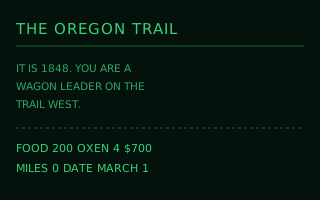
oregon is a port of the 1971 MECC overland-trail game, the one before the green
ox-and-wagon graphics, when the whole game was prompts and consequences. Your
family of five sets out from Independence, Missouri in 1847 with $700 left
after paying for the wagon. There are 2,040 miles to cover before winter.
Each turn is a fortnight (two weeks). You decide how much to eat, whether to
hunt or push on, and whether to stop at a fort. The trail answers with
riders, breakdowns, blizzards, and bad water from a sixteen-entry misfortune
table. When the game tells you to TYPE BANG (or
BLAM, POW, WHAM), type it fast and
press Enter. How quickly you type is your marksmanship, exactly as
it was on the teletypes this game was born on, printing terminals with a
keyboard and a paper roll instead of a screen.
The Oregon Trail is a trademark of Houghton Mifflin Harcourt. This mill is
an independent educational port of the 1971 MECC program, not affiliated with or
endorsed by the trademark owner. See THIRD-PARTY-NOTICES.md.
The Oregon Trail was written in 1971 by three Minnesota student teachers.
Don Rawitsch conceived it for his eighth-grade history class, and Bill
Heinemann and Paul Dillenberger wrote the BASIC. They worked on a teletype
connected to a timeshared minicomputer, one shared computer that many
keyboards used at once. Rawitsch later brought it to MECC, the Minnesota
Educational Computing Consortium. MECC's statewide network put it in front of
a generation of schoolchildren, and made it arguably the most-played piece of
educational software ever written. The BASIC listing this mill is ported
from, oregon.bas, travels in the folder beside the port. Diff
them (compare the two files line by line) if you are curious how 1971
control flow maps onto a language with no GOTO at all.
bin/mill run mills/oregon/oregon.shoddyor, from mills/oregon/, use the wrapper, ./build.sh,
or ./build.ps1 on Windows, with the same subcommands:
./build.sh          # run the game (also: ./build.sh run)
./build.sh test     # run the headless model checks
It is a plain console program (prompts in, text out, no window), so it
runs anywhere the mill does. The only timing in the game is the shooting.
The program reads Ticks() around a blocking
Input (one that waits for your answer) and scores you on the
difference. That is the same technique the original used with its
CLK function.
It also ships on the Shoddy Reckoner's games shelf: a scrolling transcript with the platform's own input line beneath it, answers travelling the pipe; it is the same woven program, unmodified.
The game is split in the standard mill shape. The pure model
is oregon-core.shoddy: the Trail record, the
outfitting and eating arithmetic, the date table, the fourteen-day travel
formula, the rider encounters, the misfortune table, the mountain crossings,
and the arrival-date computation. It includes nothing, so it runs headless
(nothing printed, nothing asked) and is checked that way by
test.shoddy. The console half is
oregon.shoddy: the instructions, the Input
prompts, the timed shooting, and the turn loop. Each turn is a pipeline of
phases. Every phase starts by standing aside if the Trail's fate is already
sealed, so a death anywhere falls straight through to the funeral. The
loop's only recursion (a function calling itself) is a self tail
call, a call made as the function's very last act, which the compiler turns
into a loop.
Two design points are worth stealing. First, randomness arrives as
a parameter wherever a roll decides a branch: did riders appear,
which misfortune struck, did the shot miss. That way every branch is
reachable deterministically from the tests: a test can steer to it on
purpose. Only rolls that merely jitter a magnitude call Rnd
directly. Second, the original's one-letter variables map one-for-one onto
named Trail fields (M is Miles,
B is Bullets, D9 is
Skill…). So the port can be audited line-against-line
with the BASIC.
The 1971 original is one BASIC listing. The port is two files, and the
seam is drawn exactly where the effects are. Everything the game
is (the Trail record and every formula and
misfortune) lives in oregon-core.shoddy. That file includes
nothing and touches nothing: no Print, no Input,
no clock. Everything the game does to you (prompts, the timed
shooting, the turn loop) lives in oregon.shoddy on top.
The payoff is test.shoddy. Because the core is pure and
every branch-deciding roll arrives as a parameter, the whole ruleset runs
headless under test. You can deterministically summon any of the sixteen
misfortunes, fail any mountain crossing, and check the arithmetic of each.
No amount of playing the interactive game could do that reliably. The
split is also the language's own convention (effects kept at the edges)
applied at program scale. The shell is the only place an effect happens,
and it is deliberately too thin to hide a bug in.
| Machine | Why | |
|---|---|---|
 | math | Included by the
console shell for exactly one word: Pick, which chooses
uniformly which of BANG, BLAM, POW, or WHAM you must type when the game
demands a shot. |
That is the whole list, and the shorter fact is the better one: the
core includes no machines at all. The 1971 game needed nothing but
arithmetic and a random number. The port keeps to that, calling the
Rnd builtin directly for its magnitude jitters.
 Shoddy · The Mills