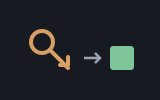
dict gives you a dictionary: a bag of values, each one filed
under a key you choose, so you can put a value in under some
name and fetch it straight back later by that same name. Look up "ADA" and
get 96; look up "LIN" and get 78. A key can be anything Shoddy can compare
with =: a number, a string, a boolean, even a whole record.
Each key holds one value at a time, so putting a new value under a key that is
already there quietly replaces the old one. Underneath, a dictionary is
an ordinary list of key/value pairs, which makes it plain and easy to
reason about. Everything is pure: DictPut and
DictDel do not change the dictionary you hand them. They hand you
back a new one with the change made, and the old one carries on unbothered.
The idea of filing a value under a key is older than computers. It is what a real dictionary does (look up a word, read its meaning), what an address book does, what the index at the back of a book does. Computing borrowed the word early and never gave it back. Different languages call the same idea different things: a map, a hash, an associative array, a dictionary. They all mean the same promise: hand me a key, I will hand you the value that goes with it.
The way this machine does it is the oldest way there is. In the LISP world of the late 1950s and 1960s, before anyone had fancy machinery for the job, people kept key/value data in an association list: literally a list of little pairs, each pair holding a key and its value. To find a key you walked the list from the front, comparing as you went, and stopped at the first pair whose key matched. That is it. No hashing, no trees, no cleverness. It was easy to build, easy to understand, and (for the short lists LISP programs usually kept) quick. The association list has never died; it is still exactly the right tool when you only have a handful of things to file away, and it is what you are looking at here.
Later, as programs grew and dictionaries got big, cleverer machinery arrived. The hash table scatters keys into numbered buckets, so a lookup jumps almost straight to the answer instead of walking the whole list. Various balanced trees keep keys in sorted order. Those are what most languages hand you today when you ask for a dictionary. This machine does not use any of that, and that is a deliberate choice. A list of pairs is what it looks like: slow in the way a stack of paper is slow, fine at the sizes it is meant for, and simple enough that you can read the whole implementation in one sitting. Shoddy by name. If a program ever needs dictionaries with thousands of entries, a hashed version could slot in behind these very same words, and nothing that calls them would need to change a line.
All the time, a program needs to remember "the thing that goes with this
other thing." The price for each product code. The score for each player. How
many times each word appeared. A setting for each option name. You could keep
two lists side by side (one of names, one of values) and promise yourself
you will always keep them lined up, but that is a promise you will break by
Tuesday. A dictionary keeps the pairing for you: one place, one lookup, no
bookkeeping. Reach for dict whenever you are tempted to say "for
each X, remember its Y": a lookup table, a tally, a little pile of named
settings. It fetches Y back when you name X, without you hunting through a
list yourself. It is built for the small stuff: a few dozen or a few hundred
entries, held in memory while your program runs. (If you need to remember
things between runs and look them up on disk by key, that is what
isam is for.)
A dictionary starts as an empty list, { }. You add to it with
DictPut, which takes the dictionary, a key, and a value, and hands
you back a new dictionary with that pairing added. Because everything is pure,
the usual shape is to keep the newest dictionary in a variable and feed it into
the next call, the same way you would build up any immutable value in Shoddy.
Include "dict.shoddy"

Def Main()
    Let d = DictPut(DictPut({ }, "ADA", 96), "LIN", 78)

    Print(DictGet(d, "ADA"))              ' 96
    Print(DictHas(d, "GRACE"))            ' False
    Print(DictGetOr(d, "GRACE", 0))       ' 0   (no such key, so the default)

    Let d2 = DictPut(d, "ADA", 100)       ' same key again: replaces 96
    Print(DictGet(d2, "ADA"))             ' 100

    Let d3 = DictDel(d2, "LIN")           ' remove LIN
    Each(DictKeys(d3), Fn(k) => Print(k)) ' ADA
A few things worth remembering:
DictPut left it untouched.DictGet raises an error if the key is not there. If a key might be
missing, check first with DictHas, or use DictGetOr,
which hands back a default of your choosing instead of stopping.DictDel gives you back a dictionary without that key,
whether or not it was ever in there, so you never have to check before
removing.=, you can file values under numbers, booleans, or
records as readily as under strings. Whatever you can compare, you can use
as a key.You do not need any of this to use the machine. It is here for the curious.
A dictionary is nothing more than a List Of Pair, built on the
Pair type from seq: each pair holds a key in
its Fst and the matching value in its Snd. The empty
dictionary is the empty list { }, and there is no wrapper type, no
hidden state, no index. What you see is the whole thing. That plainness is the
point.
Every operation is built from ordinary seq words over
that list. DictHas is Any with a test that checks each
pair's Fst against your key. DictGet walks the list by
hand, comparing the front pair's key and recursing into the rest until it either
matches or runs off the end (at which point it raises
DICTGET: KEY NOT FOUND). DictDel is Filter
keeping every pair whose key is not yours, and DictPut is
simple: it deletes the key first, then prepends a fresh pair to the
front. That is how "put" manages to replace rather than duplicate, and why the
newest value ends up at the head of the list. DictKeys and
DictVals are Map(d, Fst) and
Map(d, Snd).
What it costs. Because a lookup walks the list front to
back, comparing keys one at a time until it finds a match, the work grows in
step with the number of entries: this is a linear scan. Ten
entries, up to ten comparisons; a thousand entries, up to a thousand. Every one
of the words here (DictHas, DictGet,
DictDel, even DictPut, which deletes before it
prepends) pays that same cost. A hash table would turn most of those into a
single jump regardless of size; a sorted tree would turn them into a handful of
comparisons. A list of pairs turns them into "read the whole thing." That is
slower, and it is on purpose. At the sizes this machine is meant for, the
simplicity is worth more than the speed, and if it ever is not, a faster engine
can sit behind the same words without a single caller noticing. Shoddy by
name.
Every word, over the Pair type from seq
| Word | Description |
|---|---|
| DictPut(d, k, v) | Files value v under key
k, handing you back a new dictionary. If k was already
in d, its old value is replaced; a key never holds two values.
The dictionary you passed in is left unchanged. |
| DictDel(d, k) | Hands you back a new dictionary with key
k removed. Harmless if k was not there to begin with;
you get back a dictionary without it either way. The original is
unchanged. |
| Word | Description |
|---|---|
| DictHas(d, k) | True or False: is there a value filed under key
k? Good to check before a lookup that might miss. |
| DictGet(d, k) | Gives you the value filed under key
k. Stops the program with an error
(DICTGET: KEY NOT FOUND) if that key is not there. |
| DictGetOr(d, k, dflt) | Same as DictGet, but hands
back dflt instead of an error when the key is missing. |
| Word | Description |
|---|---|
| DictKeys(d) | Every key in the dictionary, as a list. |
| DictVals(d) | Every value in the dictionary, as a list, lined up
with the keys DictKeys gives you. |
| User | How | |
|---|---|---|
 | csv | A row zipped with its header IS an association list, which is exactly what CsvPairs hands back. |
 | html | DictHas and DictGet read an element's attribute list. |
 | https | HTTP headers are an
association list too, so HttpHeader is DictGetOr
with the name lowercased first. |
 | json | A JSON object's
members are an association list, so JGet and
JPut are DictGet and DictPut
under other names. |
 | reckoner | The registers are an association list, exactly as dict already shapes one. |
 | sparky | The put tool banks text in a register with DictPut, the same call STO makes. |
 | tally | A spec file is a dictionary: SpecGet and SpecGetOr are DictGet and DictGetOr with the key folded to upper case. |
 | xml | An element's
attributes are an association list too, so XAttr and
XPutAttr are the same two words under other names. |
| Machine | Why | |
|---|---|---|
 | seq | Any
answers the has-key question over the pair list. |
 Shoddy · The Machines