A reckoner seed: neural's feed-forward net and scaler, as dicts (machines/seeds/seedneural.shoddy)
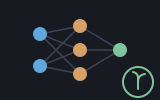
seedneural is a reckoner seed: the file that bridges
neural's words into the calculator. With it you can
build a net, train it either of two ways, scale inputs, predict, score the
result, and read or write a weight file, entirely on the stack (the
calculator's working pile of values). Per R4.16 there is no NETWORK cell at
the keyboard. A Net is a dict (a list of name-and-value pairs),
the same LIST-of-PAIR shape seeddict already
established:
{ ("w1" matrix) ("b1" list) ("w2" matrix) ("b2" list) }.
A Scaler is { ("center" list) ("spread" list) }. A
Plan is
{ ("task" str) ("rate" n) ("moment" n) ("batch" n) ("epochs" n) }.
The two constructors and the two training words are RckTouch, marked as
words whose answers may differ between calls. The constructors draw their
starting weights from Rnd, the random-number source. The
training words shuffle the row order once an epoch, that is, once per full
pass over the data. So two calls with the same arguments do not answer the
same net, exactly as typing the same line twice at a calculator prompt need
not. Everything else here is pure: the same arguments always answer the same
result.
A net is four arrays of weights. A session that has to type them out is a session that will not train one. This seed makes the whole loop (build, train, predict, score, save, load back) happen at the prompt, on cells the stack already understands. Every shape mismatch is answered as a refusal instead of ending the session.
NEURALTRAIN is regression, fitting a number rather than
picking a class. It takes scalar targets (single numbers), uses plain
gradient descent, and spreads its seven arguments across the stack.
NEURALFIT is the general form. It offers either output head,
takes target vectors rather than single numbers, and adds momentum,
a push that carries part of each training step into the next. It is driven by
a plan cell, for a plain reason: five hyperparameters (training settings)
in a fixed order on the stack is exactly the arrangement nobody can read back
a line later. Hiding either word would make the dictionary misrepresent the
machine.
Both words take a report quotation, and it is [ Drop Drop ];
it can be nothing else. The engine performs no effect, so per-epoch progress
has nobody to report to. What a session sees instead is the trained net on
the stack, plus NEURALMSE (mean squared error, the average
squared miss) or NEURALCLASSACCURACY to judge it by. That is the
same information, one line later.
neural is dimension-checked rather than forgiving. VSub and
MatVec abort on a mismatch. The mini-batch step divides by the
batch length and takes First of the batch's gradients. The epoch
step divides by the batch size. So each bad shape is refused here, before the
machine is entered, rather than after it has aborted: a row whose width is
not the net's input count, a target vector that is not its output count, a
batch size of zero, an empty training set.
One of those refusals is not about an abort at all. A batch size larger than the row count makes the epoch step tile zero mini-batches. It trains on nothing and answers the net unchanged. That reads as training that did not work, rather than as a number that was wrong. It is worse than an abort, and it is refused for that reason.
NEURALLOAD guards the same kind of quiet failure from the
other side. Val is strtod underneath (a
text-to-number reader) and it answers 0 for anything it cannot read. Without
an IsNumeric pass, a file of prose would load as a net of zeros
and predict confidently.
An earlier pass left NEURALTRAIN out. It recorded that
folding the epoch loop from inside a registered word corrupted the engine's
own state once epochs reached one. There is no such fault. The epoch fold,
the shuffle, and the report quotation invoked through Call all
thread correctly through a dictionary word's dispatch, at one epoch and at
five hundred, on a dictionary of five hundred words.
tst/seedneuraltest.shoddy trains a net to a stated MSE bound and
then goes on evaluating. That is the test that would have settled it, now
standing as an assertion rather than as a comment somebody once wrote.
Both file formats are bridged, and the binary one took a
runtime change to get there. NEURALSAVE and NEURALLOAD
carry the text pair. They can, because NetSave/NetLoad
are WriteLines/ReadLines underneath, and this seed
can reimplement those over TRYWRITEFILE/TRYREADFILE
the way seedfile already does. The binary words
(NetSaveBin, NetLoadBin, ModelSave and
ModelLoad) could not be reached that way, and an earlier pass
left them out saying so.
What stopped them was never the handle, the runtime's hold on an open
file. These words open and close inside their own bodies, so nothing R3.5(b)
is about ever happens: no handle reaches the stack, and no UNDO
can strand one. The problem was that there was no way to ask.
NetLoadBin aborts on a short or wrongly-tagged file with the
handle still open. Nothing could learn a file's size or its magic number
(the marker bytes that identify its format) without opening it first. And
BOpen is open-or-create, so the very act of checking left an
empty file behind. TryBOpen is the runtime change that answered
all three: an existing-file-only open that reports failure as a
Result. The six words below are built on it. They reuse
neural's own record layout, so the format stays one
definition and files move both ways bit for bit.
A model is a cell kind here, like a net, a scaler and a
plan: { ("net" net) ("task" str) ("prep" scaler) }. It has a
constructor and a predict of its own, not only a save and a load. A model you
can write to disk and read back but not predict with is not a bridged
feature. NEURALMODELPREDICT takes raw
inputs and does the scaling itself. That is the whole reason
neural has a Model type at all.
Below: a line fitted, then a two-class problem, both from the prompt. Both
constructors draw from Rnd and both training words shuffle. The
figures shown come from a session that typed 7 SEED first, to
fix the random numbers. Without that, yours will differ in the last digits
and not in the shape.
> 1 5 1 NEURALNEW "N" STO
ok: N
[ empty ]
> "N" RCL { { 0 } { 0.25 } { 0.5 } { 0.75 } { 1 } } { 1 1.5 2 2.5 3 } 0.1 5 500 NEURALTRAIN "T" STO
ok: T
[ empty ]
> "T" RCL { 0.5 } NEURALPREDICT
x: 2.021778542
> CLEAR "T" RCL { { 0 } { 0.25 } { 0.5 } { 0.75 } { 1 } } { 1 1.5 2 2.5 3 } NEURALMSE
x: 0.0004107328943
The truth at x = 0.5 is 2, and the net has found it to three places from five rows. Now the classifier. It wants one-hot targets (a 1 in the right class's position, 0 everywhere else) and a plan:
> CLEAR 1 6 2 NEURALNEWSCALED "C" STO 0.5 0.9 6 400 NEURALCLASSPLAN "P" STO
ok: C
ok: P
[ empty ]
> "C" RCL "P" RCL { { 0 } { 0.2 } { 0.4 } { 0.6 } { 0.8 } { 1 } } { { 1 0 } { 1 0 } { 1 0 } { 0 1 } { 0 1 } { 0 1 } } NEURALFIT "F" STO
ok: F
[ empty ]
> "F" RCL { 0.9 } NEURALCLASSOF
x: 2
> CLEAR "F" RCL { 0.9 } NEURALPROBS
x: { 1.220785985e-08 0.9999999878 }
And the guards. They are the point of the seed, not its housekeeping:
> "N" RCL { { 0 } { 0.5 } } { 1 2 3 } 0.1 1 5 NEURALTRAIN
?: NEURALTRAIN: 2 ROWS AND 3 TARGETS. THERE MUST BE ONE TARGET FOR EACH ROW
> "N" RCL { { 0 } { 0.5 } } { 1 2 } 0.1 9 5 NEURALTRAIN
?: NEURALTRAIN: BATCH MUST BE A WHOLE NUMBER FROM 1 TO 2, THE ROW COUNT
> 5 4 NEURALONEHOT
?: NEURALONEHOT: NEEDS A CLASS FROM 1 TO N, AND AN N OF 1 OR MORE| Word | Description |
|---|---|
| NEURALNEW ( ni nh no -- net ) | A new net: ni inputs, nh hidden units, no outputs, small random weights. Refuses unless all three are whole numbers of 1 or more. |
| NEURALNEWSCALED ( ni nh no -- net ) | The same, with Xavier-scaled weights and zero biases: the starting weights a wide layer needs to learn at a useful speed. |
| NEURALTRAIN ( net xs ys lr batch epochs -- net ) | Train net on the rows of xs against the single-number targets ys: learning rate lr, mini-batches of batch rows, epochs passes over the data, shuffled each pass. |
| NEURALREGRESSPLAN ( lr mu batch epochs -- plan ) | A training plan for the regression head: a dict with task, rate, moment, batch and epochs. mu is the momentum, and 0 makes this plain descent. |
| NEURALCLASSPLAN ( lr mu batch epochs -- plan ) | The same for the classification head, which reads the outputs through NEURALSOFTMAX and wants one-hot targets. |
| NEURALFIT ( net plan xs ys -- net ) | Train net on the rows of xs against the target VECTORS ys, following plan. A classify plan wants one-hot targets (NEURALONEHOT); a regress plan wants each value in a one-entry list. |
| NEURALPREDICT ( net x -- y ) | The net's scalar output for input x. |
| NEURALPROBS ( net x -- list ) | The net's outputs for x read through the classify head: probabilities that sum to 1, one per class. |
| NEURALCLASSOF ( net x -- k ) | Which class the net picks for x: the 1-based position of its largest output. |
| NEURALSOFTMAX ( list -- list ) | A list of scores as probabilities that sum to 1. Refuses on an empty list. |
| NEURALARGMAX ( list -- k ) | The 1-based position of the largest value. Refuses on an empty list. |
| NEURALONEHOT ( k n -- list ) | A target vector of n entries: 1 in position k, 0 everywhere else. Refuses unless k is a whole number from 1 to n. |
| NEURALMSE ( net xs ys -- n ) | Mean squared error over the rows of xs and the single-number targets ys. |
| NEURALACCURACY ( net xs ys pctclose -- n ) | The fraction of rows the net predicts within pctclose of the target: 0.1 for within ten percent. |
| NEURALLOGLOSS ( net xs ys -- n ) | Mean cross-entropy over the rows of xs and the one-hot targets ys. |
| NEURALCLASSACCURACY ( net xs ys -- n ) | The fraction of rows whose largest output sits where the one-hot target's 1 is. |
| NEURALSCALERFIT ( xs -- scaler ) | A scaler that centres and spreads xs's columns to mean 0: a dict with center and spread. Refuses on an empty list. |
| NEURALSCALERAPPLY ( scaler x -- x2 ) | x, centred and scaled by scaler. Refuses unless x has as many entries as the scaler was fitted with. |
| NEURALSAVE ( net path -- ok ) | Write the net's weights to a text file, one number a line, in neural's own order; True on success. |
| NEURALLOAD ( path ni nh no -- net ) | Read a weight file back into a net of ni inputs, nh hidden units and no outputs. Refuses unless the file reads, holds nothing but numbers, and holds exactly as many as that architecture needs. |
| NEURALSAVEBIN ( net path -- ok ) | Write the net to a binary file, bit-exact and self-describing, so NEURALLOADBIN needs no architecture arguments. True on success. |
| NEURALLOADBIN ( path -- net ) | Read a binary weight file back into a net. Refuses unless the file opens, carries the right marker, and is exactly the size its own header claims. |
| NEURALMODEL ( net task prep -- model ) | A model: the net, the task it was fitted for ("regress" or "classify"), and the scaler its inputs were scaled with. NEURALMODELPREDICT takes raw inputs, so the scaling cannot drift away from the net. |
| NEURALMODELSAVE ( model path -- ok ) | Write a whole model (weights, task and scaler) to one binary file. A different marker from NEURALSAVEBIN's, so the two formats can never be mistaken for one another. True on success. |
| NEURALMODELLOAD ( path -- model ) | Read a whole model back. Self-describing, so no architecture arguments. Refuses a file NEURALMODELSAVE did not write. |
| NEURALMODELPREDICT ( model x -- list ) | The model's outputs for raw, unscaled inputs x: scaled by the model's own scaler and read through its own task. The word to predict with once a model is loaded. |
| User | How | |
|---|---|---|
 | halifax | The calculator's network words: both training paths, the classifier's readers and scorers, the scaler, both weight file formats, and the whole model. |
 | sparky | Sparky folds it too, so a model calling eval reaches the same words halifax puts at a prompt. |
A mill claims this seed by folding RckSeedNeural over its
reckoner state, which is all halifax does.
| Machine | Why | |
|---|---|---|
 | cuttle | The Cell type every bridged word reads its arguments from and answers into. |
 | matrix | The Matrix cell a net's weight layers already are. |
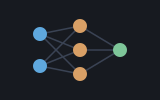 | neural | The domain this seed bridges: Net, NetNew, NetOut, Scaler, ScalerFit, ScalerApply. |
 | reckoner | RckReg and the argument readers every registered word is built from. |
 | seq | List plumbing under the net/scaler dict converters. |
 | str | Splitting and joining the lines of the text weight file, so
NEURALSAVE and NEURALLOAD need no aborting file
word. |
 Shoddy · The Machines