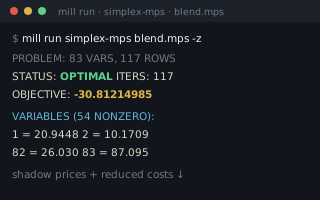
simplex-from-mps is the smallest mill and the most
industrial: a command-line solver for linear programming, the mathematics
of finding the best possible answer (biggest profit, lowest cost) under a
set of limits. Hand it an MPS file, a plain-text problem format explained
below, and it does the whole job. It loads the model with the
mps machine and optimizes with the
simplex machine. Then it reports
the works: the status, the objective value (the number being maximised or
minimised), the nonzero variables, and the sensitivity analysis, how the
answer would move if the problem moved. That analysis has two parts.
Shadow prices say what one more unit of each limit would be worth, per
normalised constraint row (an equality row appears as its +/−
pair). Reduced costs say, per variable, how far each unused variable is
from being worth using. The -z (or
--zero-lower) switch forces a zero lower bound
(x ≥ 0) on every variable, skipping a BOUNDS section
instead of reading it as rows.
If the file marks any of its columns as whole numbers, the mill notices. It answers by branch and bound instead (a search that splits the problem on each whole-number choice and discards branches that cannot win) using the mip machine. It reports the relaxation's answer (the same problem with the whole-number rule dropped), the integer one, and how many nodes and pivots the search took. Shadow prices for an integer answer are not the integer problem's own. No integer problem has them: the linear-programming dual, the mathematics behind shadow prices, does not survive the whole-number rule. So the mill pins every integer where the search left it and reports the shadow prices of the LP that remains. That question does have an answer.
MPS is a FORTRAN punch-card format that never went away. (FORTRAN is one of
the earliest programming languages; a punch card is the stiff paper card
that programs and data were once typed onto.) It is the input format of
IBM's Mathematical Programming System for the System/360, from the 1960s:
fixed sections (ROWS, COLUMNS, RHS,
BOUNDS), one coefficient per line, names in fixed columns.
Half a century later it is still the shared language of linear
programming. Every serious solver reads it, and the classic test problems
circulate in it. The bundled files/blend.mps is one of those
classics: the BLEND oil-refinery blending problem from Bruce Murtagh's
Advanced Linear Programming. files/mix.mps is a
smaller worked example to read first. files/bales.mps is the
integer one: three variables, an answer worked out by hand in its own
header, and a relaxation that recommends buying a fraction of a bale and
taking a job lot that turns out not to be worth having.
From mills/simplex-from-mps/, the wrapper is
./build.sh, or ./build.ps1 on Windows:
./build.sh build              # weave the program into bin/ (plain ./build.sh works too)
./build.sh run files/blend.mps
./build.sh clean              # remove built binaries
Like demographics, this mill is woven: once built it is a self-contained command-line program that runs with no toolchain:
dotnet bin/simplex-mps.dll files/blend.mps
dotnet bin/simplex-mps.dll files/mix.mps -z
dotnet bin/simplex-mps.dll files/bales.mps
The FILE argument is required; the run aborts without one.
Short as it is, this mill is mostly a demonstration of how much the
machines already do. mps parses the
file into a model. It hands that to
simplex or, if the file wants whole
numbers, to mip. What remains here is
the reporting: filtering the solution down to its nonzero entries and
printing shadow prices and reduced costs against their row and column
names. It is the pattern to copy when you want a Shoddy program that
behaves like a classic Unix tool: arguments in, report out, woven once to
a .dll and run anywhere .NET runs.
The file is read once, whichever kind it turns out to be. An MPS file
with no integer columns parses to a MipProblem
that has nothing to branch on. So the mill asks for that, looks at
whether the integer list is empty, and picks its reporter. It never has to
parse once to find out and again to do the work.
It is also the only single-source-file mill, and that is not an accident. The other mills split so that their pure model can be tested apart from their I/O, their input and output. Here the pure model, parsing and solving, lives entirely in the machines, and the machines carry their own tests. What is left is all reporting, and there is nothing to split.
| Machine | Why | |
|---|---|---|
 | mps | Parses the
ROWS / COLUMNS / RHS /
BOUNDS sections into a model. It normalises the rows, turns a
bound into a row of its own, and hands it all back with names attached,
plus the -z zero-lower-bound behaviour. |
 | simplex | SpOptimize
solves what the file describes: the solution status and objective, and the
sensitivity numbers (shadow prices and reduced costs) the report
prints. |
 | mip | For a file with
integer columns: MipOptimize for the answer and its node and
pivot counts, then MipFixed for the sensitivity that is
well defined once the whole numbers are settled. |
 | sparse | The form the
constraints stay in from file to solver; sparse storage keeps only the
nonzero numbers. SpNnz is what lets the report say how many
numbers a problem holds against how many cells it would have
taken. |
 | str | StartsWith
reads the command-line flags, and Join builds the little MPS
text the test suite checks the BOUNDS translation against. |
 | seq | Contains
spots -z among the arguments, and Flatten builds
the labels for the pinning rows MipFixed adds. |
 | matrix | The dense
Matrix (every cell stored, zeros included) that a plain
Problem carries. The test suite names it so it can check that
the sparse road and the dense one arrive at the same place. |
 Shoddy · The Mills